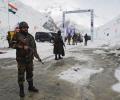
With Beijing remaining intransigent on the withdrawal of additional troops deployed by the People's Liberation Army (PLA) since the deadly border clash in 2020 in eastern Ladakh, India's bilateral ties with China remained frozen in 2023 with no forward movement on the horizon despite several rounds of diplomatic and military talks.
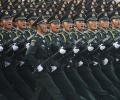
General Naravane said that the Chinese army has been trying to alter the status quo along the LAC in very 'small incremental steps' and over a period of time Beijing has gained a lot.
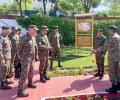
'India today feels enough is enough and we need to teach Pakistan a lesson.' 'Unless compelled, Mr Modi will think 10 times before taking the extreme step.'

"He told me his (retirement) papers were through and he would return home in a weeks time and asked me to go ahead with the house warming ceremony on June 3 which I did," she said.
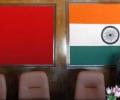
India and China have agreed to take measures to further ease the situation at the borders while continuing to implement the October agreement to resolve the standoff in eastern Ladakh comprehensively. The two sides held the 32nd meeting of the Working Mechanism for Consultation & Coordination on China-India Border Affairs (WMCC) in New Delhi, agreeing to maintain communication through diplomatic and military channels and safeguard sustainable peace and stability in the border areas. This meeting follows the October 21 agreement between the two countries to resolve the over four-year-long military standoff in eastern Ladakh.

In the meeting, Doval conveyed to Wang that peace and tranquillity in border areas and respect for the Line of Actual Control are essential for return of normalcy in bilateral ties, according to the ministry of external affairs.

Chinese Foreign Minister Wang Yi has expressed readiness to join hands with India's National Security Advisor Ajit Doval to "properly handle" issues related to the situation on the ground in the border areas, amid the protracted border row in eastern Ladakh.

The Indian Army has commenced a verification patrolling at Depsang, the second friction point in eastern Ladakh, the government said on Saturday.

Prime Minister Narendra Modi and Chinese President Xi Jinping will hold bilateral talks on Wednesday on the margins of the Brazil, Russia, India, China, South Africa (BRICS) summit in Russia, in their first structured meeting since the eastern Ladakh border row erupted in May 2020.

The exchange took place at five Border Personnel Meeting points along the LAC, the sources added.

Indian military sources said no firearms were used in the clashes and that most of the injuries were sustained following stone-pelting and use of rods by the Chinese side.

The 30-member committee, chaired by senior Bharatiya Janata Party leader and former Union minister Jual Oram and of which Rahul Gandhi is also a member,wishes to visit the eastern Ladakh region in the last week of May or in June.

The sources have said that patrolling will begin at these points once the disengagement that began last week is completed and both sides will move their respective troops and dismantle temporary structures.

Weidong said India and China "should live in peace and avoid conflicts."

A broad consensus has been achieved by India and China on restoring the 'ground situation' along the Line of Actual Control (LAC) pursuant to talks, including for patrolling and grazing cattle in the traditional areas, Defence Minister Rajnath Singh said on Thursday.

Union minister Kiren Rijiju on Friday said he interacted with soldiers of China's People's Liberation Army along the Sino-Indian border near Tawang during a visit to an Indian Army post on Diwali.

The virtual talks took place under the framework of Working Mechanism for Consultation and Coordination on India-China Border Affairs.

Jaishankar also spoke about how he expected a change in Russia's direction towards the rest of the world and it may likely want multiple options in Asia.

The Indian Army began patrolling at Demchok on Friday, days after Indian and Chinese troops completed disengagement at the two friction points in eastern Ladakh, Army sources said.

Lt Gen Y K Joshi, the General Officer Commanding-in-Chief of the Army's Northern Command, in an exclusive interview to CNN-News18, has said no land has been ceded to China. "No, a very emphatic no actually," he said while speaking to CNN-News18's Defence Editor Shreya Dhoundial.

The situation along the Line of Actual Control (LAC) in eastern Ladakh is stable but sensitive and not normal, Chief of Army Staff General Upendra Dwivedi said on Tuesday on the dragging military standoff between China and India in the region.

Dominic Xavier offers his take on China fielding a soldier involved in the Galwan Valley clash as a torchbearer for the Beijing Winter Olympics.

Jaishankar said, "The immediate part which awaits us is what we call the de-escalation, which is the build-up of forces along the Line of Actual Control."

The ministry of external affairs on Wednesday said the talks were held in an "open and constructive manner" for an early and mutually acceptable resolution of the remaining issues.
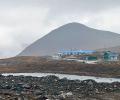
The move bears significance in view of the increased Chinese activities along the border and transgressions by China's People's Liberation Army (PLA).
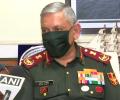
'Chinese soldiers don't have much experience of fighting in these kinds of areas and operating in this kind of terrain'

'In the short term the relationship will get worse.'

Without mentioning the boundary dispute, the spokesperson said that China-India relations have been stable on the whole and "our two sides have maintained dialogue and communication at various levels".

India is not "rethinking" supporting investments from China, said Commerce and Industry Minister Piyush Goyal on Tuesday, referring to a proposal made in the Economic Survey 2024. The survey by India's chief economic advisor last week said India had two "choices" to benefit from the so-called China plus one strategy, either by integrating into that country's supply chain or by promoting foreign direct investment (FDI). "Chief economic advisor's report speaks about new ideas and gives out their own thinking. It is not at all binding on the government and there is no rethinking to support Chinese investments in the country," Goyal told reporters in Delhi.
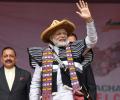
New Delhi's reaction came in response to Beijing announcing Chinese names for 11 more places in Arunachal Pradesh which the neighbouring country claims as southern part Tibet.

'The future of BRICS is under stress as Chinese attempts to expand the platform are being resisted by India and Brazil.' 'Beijing is focused on a quick expansion with the aim of giving the platform a distinctly anti-Western orientation, which New Delhi and Brasilia seem to have no interest in,' notes Harsh V Pant.
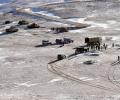
The Indian and Chinese troops are locked in an over three-year confrontation in certain friction points in eastern Ladakh even as the two sides completed disengagement from several areas following extensive diplomatic and military talks.
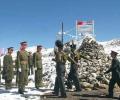
China on Wednesday said the latest round of the border talks with India was held in a "candid and pragmatic atmosphere" and the two sides had a "positive, constructive and in-depth discussion" on the resolution of the remaining issues along the Line of Actual Control in the Western Sector.

In their first structured bilateral talks in nearly five years, Prime Minister Narendra Modi and Chinese President Xi Jinping Wednesday agreed that India and China can have a 'peaceful and stable' relationship by displaying maturity and mutual respect and endorsed the pact on the resolution of the dragging eastern Ladakh border row.

Glimpses from Yudh Abhyas, the India-US military exercise currently being conducted in Tapovan, Uttarakhand, 100 km away from the Line of Actual Control.

'If you behave like a nail, the adversary will behave like a hammer.'

You don't want to fight and do trade at the same time. Meanwhile, diplomacy is going on and sometimes solutions to difficult situations do not come in haste, Jaishankar asserted.

In underlining the role of border villages as custodians of India's frontiers, New Delhi is following China's example in Tibet.

In a year bookended by intractable conflicts and geopolitical fragmentation, India focused on ramping up military prowess by broadly firming up defence procurement worth Rs 4.22 lakh crore even as Indian and Chinese militaries completed pulling back their troops from border face-off points in eastern Ladakh.
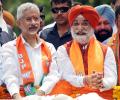
Jaishankar said diplomacy is a work of patience and India continues to discuss the issues with the Chinese side.
 © 2026 Rediff.com - Advertise with us - Disclaimer - Privacy Policy - Sitemap - Feedback - About us - Terms of use - Grievances